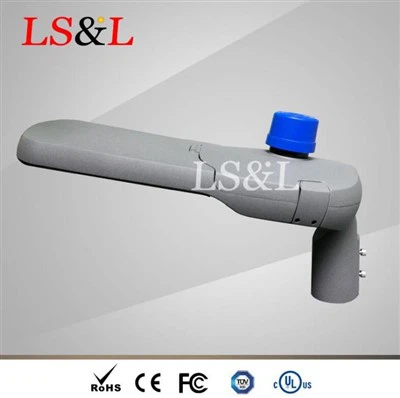
A road contractor in Dubai ordered 60 units for a four-lane industrial access road. The supplier listed them as 200W LED street light and quoted AED 320 each, well below the market rate. When the units arrived, the photometrics showed 22,000 lumens instead of the 30,000 they had priced in. Eighteen months later, 23 of them had dark spots on the road surface and three had stopped working entirely. The contractor had to replace them at AED 180,000 out of pocket. The lesson is that a 200W LED street light is not a commodity number. The lumen output, the LED brand, the driver and the pole height all decide whether it actually does the job.
What a 200W LED street light actually outputs
A genuine 200W LED street light, built with good LED chips and an efficient driver, outputs between 28,000 and 32,000 lumens. The efficacy should be 140 to 160 lumens per watt. If a supplier quotes 200W but only 20,000 lumens, the unit is either using cheap chips, an inefficient driver, or both. Ask for the lm/W figure on the specification sheet, not just the wattage. A 200W LED street light that delivers 30,000 lumens is roughly equivalent to a 600 to 800 watt high pressure sodium lamp, which is what most roads are being converted from. We cover the lower end of the range in our 100W LED street light guide, and the higher end in our 400W LED street light article.
A 200W LED street light is designed for poles between 8 and 12 meters high. Below 8 meters, it is over-powered and creates glare. Above 12 meters, you step up to a 300W or 400W unit. On an 8 to 10 meter pole, space the fixtures 30 to 40 meters apart on a single-sided mounting, or 25 to 35 meters on a dual-sided mounting across the road. If the road is wider than 12 meters, you need either dual-sided poles or a higher wattage. Get a photometrics layout drawn before you order, because spacing and pole height are linked. A 200W unit on a 6 meter pole will look like a floodlight, not a street light.
A 200W LED street light for outdoor use must be IP66. IP65 is acceptable for sheltered positions, but a main road or industrial park needs IP66 to survive jet washing and heavy rain. The optics are just as important. A street light uses secondary lenses, usually Type II, III or V, to shape the light along the road rather than flooding it sideways. Ask for the optical type. A cheap 200W unit with no proper optics will throw light onto private property and generate complaints. A built-in photocell that turns the light on at dusk and off at dawn is standard. Dusk-to-dawn saves roughly 30 percent of the energy bill compared to a timer that runs until midnight.
AC versus solar for a 200W unit
A grid-connected 200W LED street light draws about 0.9 amps at 230V. It is the standard choice for roads where power is already available. A solar 200W equivalent needs a battery pack of roughly 200 to 300 watt-hours and a solar panel of 300 to 400 watts. That solar unit costs two to three times more upfront. We break down the trade-offs in our solar LED street light buying guide. For a new industrial park or a rural road with no grid connection, solar is worth the premium. For an existing road retrofit, grid-connected is cheaper and simpler.
Common mistakes when buying a 200W street light
The first mistake is buying on wattage alone. The second is buying on price alone. A genuine 200W unit with name-brand LEDs and a Mean Well or Philips driver costs between USD 80 and USD 160 FOB. If a supplier quotes USD 40 to USD 60, something is being cut. The third mistake is skipping the photometrics file. Ask for the IES file, load it into Dialux, and check the road illuminance before you commit. The fourth mistake is forgetting the mounting bracket. A 200W head weighs 6 to 9 kilograms, and the slip fitter or trunnion bracket must match the pole arm diameter.
How much does a 200W LED street light cost? A genuine unit with name-brand LEDs and a certified driver lands between USD 80 and USD 160 FOB. Solar versions with panel and battery run USD 350 to USD 600 per set.
What pole height do I need? 8 to 12 meters. Below 8 meters the unit is over-powered; above 12 meters you need a higher wattage.
What spacing? 30 to 40 meters on a single-sided mount, 25 to 35 meters dual-sided. Confirm with a photometrics layout.
How long does it last? 50,000 hours at 25 degrees ambient. In a hot climate like the Middle East or the American Southwest, expect 35,000 to 40,000 hours.
Can I dim a 200W LED street light? Yes, if you specify 0-10V or NEMA dimming at order time. Most units are non-dimmable, but smart dimming on a timer or motion sensor can cut energy use by another 20 percent.
A 200W LED street light is a long-term road asset. Specify the lumen output, optical type, IP rating and pole height before you send an RFQ. If you are sourcing for a road retrofit, industrial park, port area or large parking lot, our 200W LED street light range lists the units we supply with name-brand LEDs and certified drivers. Send your road layout, pole height, quantity and destination port through our inquiry form and we will come back with a unit price, photometrics and lead time within one working day.